A report by the Czech academic center Sinopsis highlights “major donations” by United Front’s “heavyweights” to finance French “influence diplomacy.”
by Massimo Introvigne
The two CCP
It stands for Chinese Communist Party, which from 1949 controls all social and political life in China. Members of CCP should in principle be self-proclaimed atheists. The ultimate goal of CCP is suppression of religion. However, how this goal is achieved has varied during time, and after Chairman Mao’s death the CCP has acknowledged that, notwithstanding its efforts, religions may survive in China for a long time.
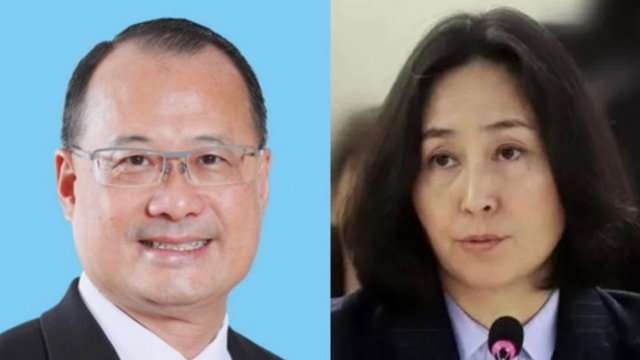
» href= »https://bitterwinter.org/Vocabulary/ccp/ » target= »_blank » data-gt-translate-attributes= »[{ » attribute= » »>CCP “almoners” supporting French “influence diplomacy,” Jonathan Choi and Pansy Ho. Sources: Twitter and Sinopsis.
A very detailed report published on May 11 by the authoritative Czech project Sinopsis, the result of the cooperation between the NGO AcaMedia and the Department of Sinology at Charles University in Prague, unveils a curious relationship between France’s “cultural and influence diplomacy” and the Chinese Communist Party (CCP
It stands for Chinese Communist Party, which from 1949 controls all social and political life in China. Members of CCP should in principle be self-proclaimed atheists. The ultimate goal of CCP is suppression of religion. However, how this goal is achieved has varied during time, and after Chairman Mao’s death the CCP has acknowledged that, notwithstanding its efforts, religions may survive in China for a long time.
» href= »https://bitterwinter.org/Vocabulary/ccp/ » target= »_blank » data-gt-translate-attributes= »[{ » attribute= » »>CCP). In short, France gets money from the CCP
It stands for Chinese Communist Party, which from 1949 controls all social and political life in China. Members of CCP should in principle be self-proclaimed atheists. The ultimate goal of CCP is suppression of religion. However, how this goal is achieved has varied during time, and after Chairman Mao’s death the CCP has acknowledged that, notwithstanding its efforts, religions may survive in China for a long time.
» href= »https://bitterwinter.org/Vocabulary/ccp/ » target= »_blank » data-gt-translate-attributes= »[{ » attribute= » »>CCP to fund its most important diplomatic project.
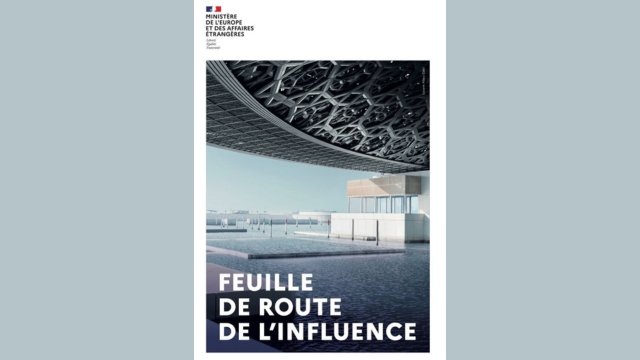
To understand what this new major scandal involving France is all about, we need to introduce the main characters of the comedy. The first is the French Ministry of Foreign Affairs, which in December 2021 launched its “Roadmap for Influence.” Through this ambitious project of “cultural and influence diplomacy,” France plans to win what it presents as the real main battle of the 21st century, “the struggle for influence [that] is also a fight between narratives and, ultimately, models.”
The French “Roadmap for Influence.”
The second character is President Macron. He is all in favor of “cultural and influence diplomacy” as an expression of French “grandeur” and a way of exporting the values of “la République” internationally—but he is also painfully aware that his budget is limited, and he leads a country where citizens take to the streets protesting painful cuts in the field of pensions and other social services. So, his message is: go on with this wonderful project but try to find funds from private donors.
The third character, not mentioned in the Czech report but not unimportant, is the MIVILUDES, the French governmental agency combating “cults.” It is under constant criticism by NGOs, academic scholars, and the United States agencies producing reports on Religious liberty
The right to profess freely a religious belief. "Everyone has the right to freedom of thought, conscience and religion; this right includes freedom to change his religion or belief, and freedom, either alone or in community with others and in public or private, to manifest his religion or belief in teaching, practice, worship and observance” (Universal Declaration of Human Rights, Art. 18). "Practice” includes the liberty to proselytize. United Nations’ General Comment no. 22 also specifies that "Article 18 protects theistic, non-theistic and atheistic beliefs, as well as the right not to profess any religion or belief. The terms ‘belief’ and ‘religion’ are to be broadly construed. Article 18 is not limited in its application to traditional religions or to religions and beliefs with institutional characteristics or practices analogous to those of traditional religions” and protects also religions that are "newly established, or represent religious minorities that may be the subject of hostility on the part of a predominant religious community.”
» href= »https://bitterwinter.org/Vocabulary/religious-liberty/ » target= »_blank » data-gt-translate-attributes= »[{ » attribute= » »>religious liberty for its systematic violations of freedom of religion or belief. It needs the French “cultural and influence diplomacy” to support it internationally and persuade other countries that the French anti-Cult
A term used by opponents to identify religious movements they regard as malignant or dangerous. Because of its judgmental and controversial use, it was largely abandoned by the academia since the 1980s, and replaced by "new religious movement.” The same derogatory role is played in German (<em>sekte</em>), French (<em>secte</em>), Italian (<em>setta</em>) and Spanish (<em>secta</em>) by words literally translating the English "sect.” In this context each of these terms should be translated as "cult” rather than "sect,” and vice versa "cult” in English should be translated as <em>sekte</em>, <em>secte</em>, <em>setta</em>, <em>secta.</em>
» href= »https://bitterwinter.org/Vocabulary/cult/ » target= »_blank » data-gt-translate-attributes= »[{ » attribute= » »>cult fight is reasonable. You do not need to take Bitter Winter’s word for this. The MIVILUDES itself explains in its reports that the French position on “cults”—and “separatism,” i.e., the fight, regarded in some Muslim countries as Islamophobic, against communities that want to live “separately” from the values of the majority, based on their religion— is not necessarily appreciated abroad. It adds that France is at work diplomatically to explain its reasons internationally, and persuade other countries to join the anti-Cult
A term used by opponents to identify religious movements they regard as malignant or dangerous. Because of its judgmental and controversial use, it was largely abandoned by the academia since the 1980s, and replaced by "new religious movement.” The same derogatory role is played in German (<em>sekte</em>), French (<em>secte</em>), Italian (<em>setta</em>) and Spanish (<em>secta</em>) by words literally translating the English "sect.” In this context each of these terms should be translated as "cult” rather than "sect,” and vice versa "cult” in English should be translated as <em>sekte</em>, <em>secte</em>, <em>setta</em>, <em>secta.</em>
» href= »https://bitterwinter.org/Vocabulary/cult/ » target= »_blank » data-gt-translate-attributes= »[{ » attribute= » »>cult fight. This is obviously part of French “cultural and influence diplomacy.”
The fourth character is China’s United Front
An alliance including the CCP, eight minor parties allowed to exist only to claim that in China there is more than one party, and the allegedly "independent” All China Federation of Industry and Commerce. For all practical purposes, the United Front is a tool of the CCP, but Chairman Mao believed that, by not using the name CCP, it was an extremely effective organization both in China and abroad. It was less important under Mao’s successors, but its role has been restored as central with the presidency of Xi Jinping.
» href= »https://bitterwinter.org/Vocabulary/united-front/ » target= »_blank » data-gt-translate-attributes= »[{ » attribute= » »>United Front. In theory, the United Front
An alliance including the CCP, eight minor parties allowed to exist only to claim that in China there is more than one party, and the allegedly "independent” All China Federation of Industry and Commerce. For all practical purposes, the United Front is a tool of the CCP, but Chairman Mao believed that, by not using the name CCP, it was an extremely effective organization both in China and abroad. It was less important under Mao’s successors, but its role has been restored as central with the presidency of Xi Jinping.
» href= »https://bitterwinter.org/Vocabulary/united-front/ » target= »_blank » data-gt-translate-attributes= »[{ » attribute= » »>United Front is the alliance between the Chinese Communist Party, eight minor legally permitted parties, and the All-China Federation of Industry and Commerce. In practice, the United Front
An alliance including the CCP, eight minor parties allowed to exist only to claim that in China there is more than one party, and the allegedly "independent” All China Federation of Industry and Commerce. For all practical purposes, the United Front is a tool of the CCP, but Chairman Mao believed that, by not using the name CCP, it was an extremely effective organization both in China and abroad. It was less important under Mao’s successors, but its role has been restored as central with the presidency of Xi Jinping.
» href= »https://bitterwinter.org/Vocabulary/united-front/ » target= »_blank » data-gt-translate-attributes= »[{ » attribute= » »>United Front is the main CCP
It stands for Chinese Communist Party, which from 1949 controls all social and political life in China. Members of CCP should in principle be self-proclaimed atheists. The ultimate goal of CCP is suppression of religion. However, how this goal is achieved has varied during time, and after Chairman Mao’s death the CCP has acknowledged that, notwithstanding its efforts, religions may survive in China for a long time.
» href= »https://bitterwinter.org/Vocabulary/ccp/ » target= »_blank » data-gt-translate-attributes= »[{ » attribute= » »>CCP propaganda agency, which in the words of Xi Jinping
The secretary of the CCP since 2012 and the president of China since 2013. He has promoted a personal dictatorship and a cult of his personality reminiscent of Chairman Mao, and a crackdown on all religions stronger than in the previous decades, which found its legal expression in the new Regulation on Religious Affairs.
» href= »https://bitterwinter.org/Vocabulary/xi-jinping/ » target= »_blank » data-gt-translate-attributes= »[{ » attribute= » »>Xi Jinping himself should try to control “how China is perceived internationally.” Although that the United Front
An alliance including the CCP, eight minor parties allowed to exist only to claim that in China there is more than one party, and the allegedly "independent” All China Federation of Industry and Commerce. For all practical purposes, the United Front is a tool of the CCP, but Chairman Mao believed that, by not using the name CCP, it was an extremely effective organization both in China and abroad. It was less important under Mao’s successors, but its role has been restored as central with the presidency of Xi Jinping.
» href= »https://bitterwinter.org/Vocabulary/united-front/ » target= »_blank » data-gt-translate-attributes= »[{ » attribute= » »>United Front is part and parcel of the CCP
It stands for Chinese Communist Party, which from 1949 controls all social and political life in China. Members of CCP should in principle be self-proclaimed atheists. The ultimate goal of CCP is suppression of religion. However, how this goal is achieved has varied during time, and after Chairman Mao’s death the CCP has acknowledged that, notwithstanding its efforts, religions may survive in China for a long time.
» href= »https://bitterwinter.org/Vocabulary/ccp/ » target= »_blank » data-gt-translate-attributes= »[{ » attribute= » »>CCP is obvious to all those familiar with China, for foreign recipients of donations it is sometimes more elegant to receive money from the United Front
An alliance including the CCP, eight minor parties allowed to exist only to claim that in China there is more than one party, and the allegedly "independent” All China Federation of Industry and Commerce. For all practical purposes, the United Front is a tool of the CCP, but Chairman Mao believed that, by not using the name CCP, it was an extremely effective organization both in China and abroad. It was less important under Mao’s successors, but its role has been restored as central with the presidency of Xi Jinping.
» href= »https://bitterwinter.org/Vocabulary/united-front/ » target= »_blank » data-gt-translate-attributes= »[{ » attribute= » »>United Front than directly from the Communist Party or Beijing’s government. Better still, they receive money from private businesspersons who operate as “almoners” of the United Front
An alliance including the CCP, eight minor parties allowed to exist only to claim that in China there is more than one party, and the allegedly "independent” All China Federation of Industry and Commerce. For all practical purposes, the United Front is a tool of the CCP, but Chairman Mao believed that, by not using the name CCP, it was an extremely effective organization both in China and abroad. It was less important under Mao’s successors, but its role has been restored as central with the presidency of Xi Jinping.
This leads us to introduce two other characters, who figure prominently in the Czech report: Jonathan Choi Koon-shum (蔡冠深) and Pansy Catalina Ho Chiu-king (何超琼). They are both billionaire businesspersons. Choi is from Hong Kong and is the son of Choi Kai-you, the pro-Chinese “King of Seafood.” Ho is from Macau and is the daughter of Stanley Ho, “the King of Gambling,” rumored, truly or falsely, to be connected with the Chinese mafia. Stanley Ho, who always denied the mafia connections, was a member of China’s National People’s Congress and was on the Standing Committee of the Chinese People’s Political Consultative Conference (CPPCC), the most important United Front
An alliance including the CCP, eight minor parties allowed to exist only to claim that in China there is more than one party, and the allegedly "independent” All China Federation of Industry and Commerce. For all practical purposes, the United Front is a tool of the CCP, but Chairman Mao believed that, by not using the name CCP, it was an extremely effective organization both in China and abroad. It was less important under Mao’s successors, but its role has been restored as central with the presidency of Xi Jinping.
» href= »https://bitterwinter.org/Vocabulary/united-front/ » target= »_blank » data-gt-translate-attributes= »[{ » attribute= » »>United Front forum. There would have been no contradictions between being a United Front
An alliance including the CCP, eight minor parties allowed to exist only to claim that in China there is more than one party, and the allegedly "independent” All China Federation of Industry and Commerce. For all practical purposes, the United Front is a tool of the CCP, but Chairman Mao believed that, by not using the name CCP, it was an extremely effective organization both in China and abroad. It was less important under Mao’s successors, but its role has been restored as central with the presidency of Xi Jinping.
» href= »https://bitterwinter.org/Vocabulary/united-front/ » target= »_blank » data-gt-translate-attributes= »[{ » attribute= » »>United Front leader and connected with the mafia, since the CCP
It stands for Chinese Communist Party, which from 1949 controls all social and political life in China. Members of CCP should in principle be self-proclaimed atheists. The ultimate goal of CCP is suppression of religion. However, how this goal is achieved has varied during time, and after Chairman Mao’s death the CCP has acknowledged that, notwithstanding its efforts, religions may survive in China for a long time.
» href= »https://bitterwinter.org/Vocabulary/ccp/ » target= »_blank » data-gt-translate-attributes= »[{ » attribute= » »>CCP in its history repeatedly cultivated underground alliances with Chinese organized crime.
Jonathan Choi and Pansy Ho have been depicted since the last decade in French media as philanthropists in love with French culture and generously supporting French museums and universities, with a coordinated emphasis that betrays the work of public relations agencies. “Le Figaro” called Jonathan Choi a hero and even compared him to a Buddha. No French media, however, explained that both Jonathan Choi and Pansy Ho are members of the Standing Committee of the Chinese People’s Political Consultative Conference (CPPCC). The Czech report lists all their positions in United-Front-related organizations and concludes that they are “United Front
An alliance including the CCP, eight minor parties allowed to exist only to claim that in China there is more than one party, and the allegedly "independent” All China Federation of Industry and Commerce. For all practical purposes, the United Front is a tool of the CCP, but Chairman Mao believed that, by not using the name CCP, it was an extremely effective organization both in China and abroad. It was less important under Mao’s successors, but its role has been restored as central with the presidency of Xi Jinping.
» href= »https://bitterwinter.org/Vocabulary/united-front/ » target= »_blank » data-gt-translate-attributes= »[{ » attribute= » »>United Front heavyweights.” Whether they use their own or United Front
An alliance including the CCP, eight minor parties allowed to exist only to claim that in China there is more than one party, and the allegedly "independent” All China Federation of Industry and Commerce. For all practical purposes, the United Front is a tool of the CCP, but Chairman Mao believed that, by not using the name CCP, it was an extremely effective organization both in China and abroad. It was less important under Mao’s successors, but its role has been restored as central with the presidency of Xi Jinping.
» href= »https://bitterwinter.org/Vocabulary/united-front/ » target= »_blank » data-gt-translate-attributes= »[{ » attribute= » »>United Front’s money to finance French activities is less important than the fact that their “people-to-people diplomacy” (as China calls it) is obviously not a civil society activity but a strategy deployed by and on behalf of the United Front
An alliance including the CCP, eight minor parties allowed to exist only to claim that in China there is more than one party, and the allegedly "independent” All China Federation of Industry and Commerce. For all practical purposes, the United Front is a tool of the CCP, but Chairman Mao believed that, by not using the name CCP, it was an extremely effective organization both in China and abroad. It was less important under Mao’s successors, but its role has been restored as central with the presidency of Xi Jinping.
» href= »https://bitterwinter.org/Vocabulary/united-front/ » target= »_blank » data-gt-translate-attributes= »[{ » attribute= » »>United Front, i.e., of the CCP
It stands for Chinese Communist Party, which from 1949 controls all social and political life in China. Members of CCP should in principle be self-proclaimed atheists. The ultimate goal of CCP is suppression of religion. However, how this goal is achieved has varied during time, and after Chairman Mao’s death the CCP has acknowledged that, notwithstanding its efforts, religions may survive in China for a long time.
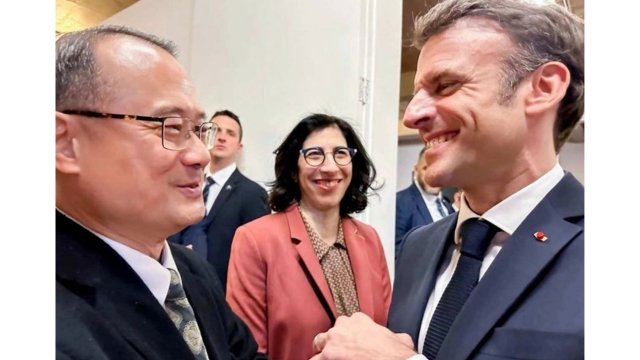
Jonathan Choi with President Macron. Source: Sinopsis.
When France launched its “cultural and influence diplomacy,” and looked for private donors to support it, Choi and Ho were there to help. According to the Czech report, “Choi’s known donations amount to more than 2,5 million euros, to which must be added those whose amount has not been disclosed.” Ho has been very careful not to disclose the amounts she donated, but they are also substantial. As major donors, Choi and Ho have direct accept to President Macron and other key French political figures. The Czech report suggests that they influence French political positions on Hong Kong and Taiwan, and operate in general to put brakes on France’s criticism of Human Rights
The fundamental rights of all human beings to life, freedom, justice, and safety, defined by the Universal Declaration of Human Rights of 1948.
» href= »https://bitterwinter.org/Vocabulary/human-rights/ » target= »_blank » data-gt-translate-attributes= »[{ » attribute= » »>human rights violations in China.
But the United Front
An alliance including the CCP, eight minor parties allowed to exist only to claim that in China there is more than one party, and the allegedly "independent” All China Federation of Industry and Commerce. For all practical purposes, the United Front is a tool of the CCP, but Chairman Mao believed that, by not using the name CCP, it was an extremely effective organization both in China and abroad. It was less important under Mao’s successors, but its role has been restored as central with the presidency of Xi Jinping.
» href= »https://bitterwinter.org/Vocabulary/united-front/ » target= »_blank » data-gt-translate-attributes= »[{ » attribute= » »>United Front is surely glad to support the diplomatic export of French positions on “cults” as well. French private and governmental anti-Cult
A term used by opponents to identify religious movements they regard as malignant or dangerous. Because of its judgmental and controversial use, it was largely abandoned by the academia since the 1980s, and replaced by "new religious movement.” The same derogatory role is played in German (<em>sekte</em>), French (<em>secte</em>), Italian (<em>setta</em>) and Spanish (<em>secta</em>) by words literally translating the English "sect.” In this context each of these terms should be translated as "cult” rather than "sect,” and vice versa "cult” in English should be translated as <em>sekte</em>, <em>secte</em>, <em>setta</em>, <em>secta.</em>
» href= »https://bitterwinter.org/Vocabulary/cult/ » target= »_blank » data-gt-translate-attributes= »[{ » attribute= » »>cult organizations have cooperated with China since the early years of the persecution of Falun Gong
(法輪功). A large Chinese new religious movement, established by Li Hongzhi (李洪志) in 1992 and teaching both a variety of qi gong exercises and a spirituality rooted in the Three Teachings, with some New Age variations and overtones. Originally tolerated and even praised by the CCP as part of a legitimate revival of traditional Chinese health practices, it created concern in the authorities because of its rapid growth. It was banned in 1999, included in the list of the <em>xie jiao</em>, and severely persecuted.
» href= »https://bitterwinter.org/Vocabulary/falun-gong/ » target= »_blank » data-gt-translate-attributes= »[{ » attribute= » »>Falun Gong. They would do this even for free, for ideological reasons—but certainly the monetary support from the United Front
An alliance including the CCP, eight minor parties allowed to exist only to claim that in China there is more than one party, and the allegedly "independent” All China Federation of Industry and Commerce. For all practical purposes, the United Front is a tool of the CCP, but Chairman Mao believed that, by not using the name CCP, it was an extremely effective organization both in China and abroad. It was less important under Mao’s successors, but its role has been restored as central with the presidency of Xi Jinping.
» href= »https://bitterwinter.org/Vocabulary/united-front/ » target= »_blank » data-gt-translate-attributes= »[{ » attribute= » »>United Front to French “cultural and influence diplomacy” makes this merry cooperation even merrier.
Ce site utilise des cookies pour améliorer votre expérience. Nous supposerons que cela vous convient, mais vous pouvez vous désinscrire si vous le souhaitez.
J'accepteLire la suite