
France and England. Football teams created by immigration. Countries confused by it.
Follow France vs England live at World Cup 2022.
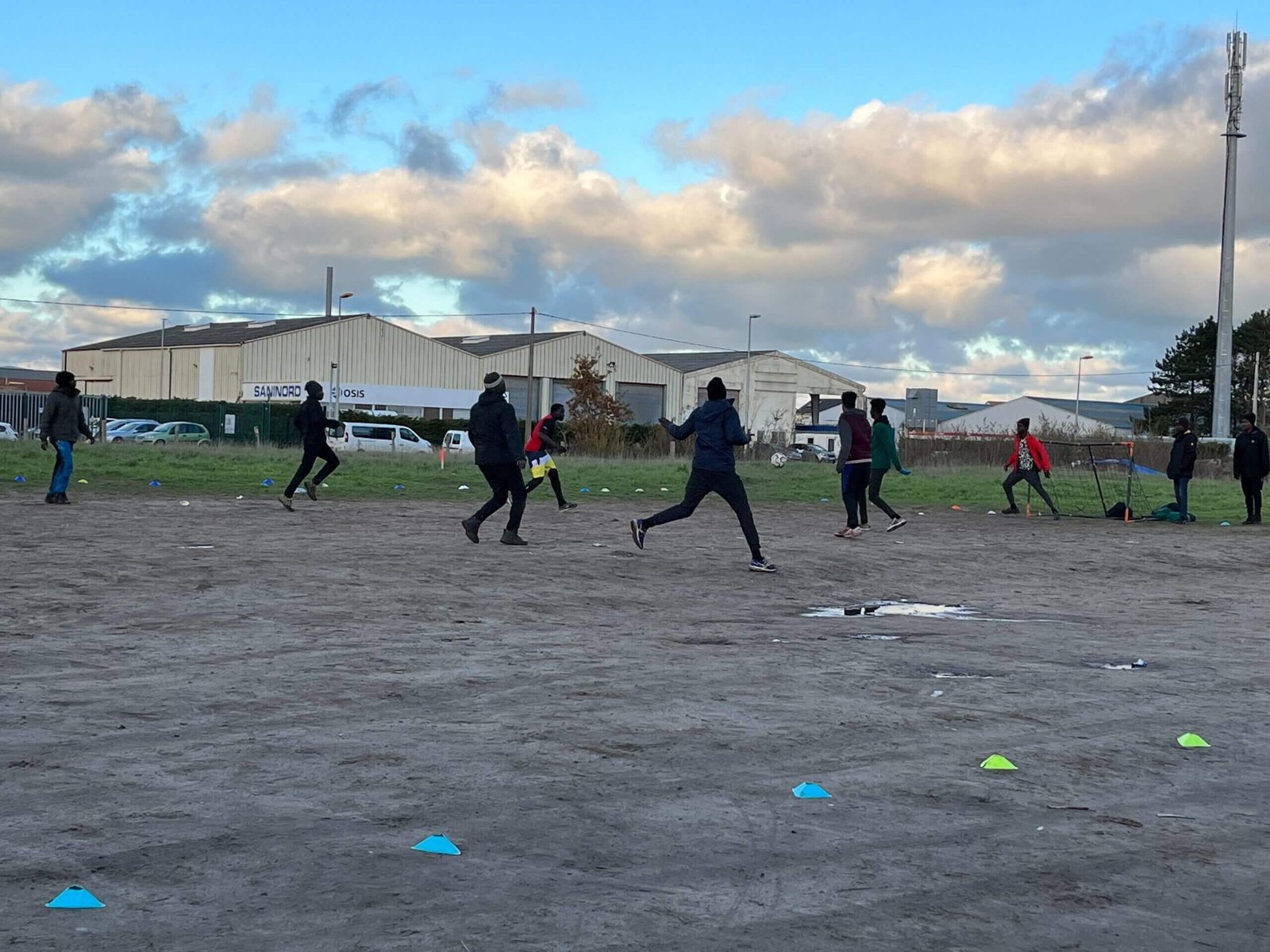
The scene is a patch of muddy scrubland just off Rue de Jude on the eastern fringes of Calais. A pitch has been marked out with coloured plastic training cones. There are metal five-a-side goals at each end, all battered, bent and precarious yet complete with nets, and a playful argument has just erupted.
It centres on whether one of the Sudanese nominally guarding the northern goal had slid across in time to clear a shot from inside his left post. The scorer, clad in a bright orange T-shirt and tweed trousers, is certain the ball had been hooked from beyond the line and, arms spread wide, is already charging back towards his compatriots gathered at the far end to celebrate an impressively taken winner.
Behind him, there is much finger-wagging and denial, but no goal-line technology to provide a definitive resolution.
Those present have travelled thousands of miles from their homelands, fleeing war, religious persecution and political repression, forever craving a better life. Many have left their families behind. Others still hope to join relatives across the Channel in the United Kingdom, tantalisingly close, just 30 miles away across the water. They are not wanted here, and not welcome there. They are in limbo, Calais lost souls. But, for now at least, they are not thinking about reality and, instead, are engrossed in their kickabout.
All is raucous. It is bitterly cold, the game-defining goal is contentious, but everywhere there are smiles. The din of delight and mock outrage, mixing with the general hubbub and thrum of music from the neighbouring tables and workstations, feels incongruous given the bleak landscape and everything these refugees confront daily.
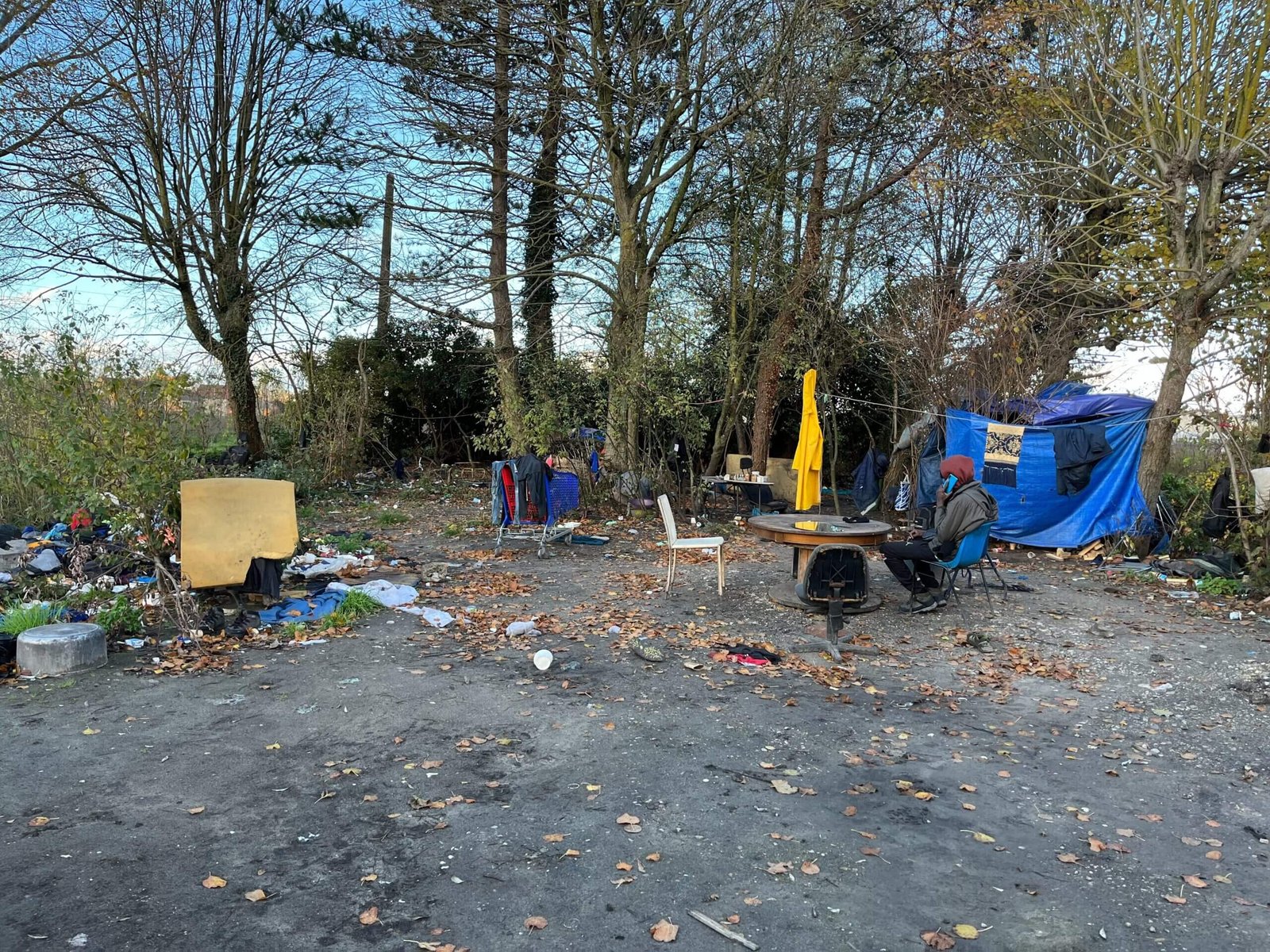
A stones throw away lies a copse of thinning trees shelter of sorts where some have thrown together a ramshackle camp given more permanent sites have been off the agenda since the closure of the one known as the Jungle in 2016. Temperatures are due to plummet further. Cases of diphtheria, COVID-19 and scabies are rapidly on the rise.
Plenty of the local residents are hostile and the police mount regular raids to confiscate tents, tarpaulins and bedding and move the migrants on, sometimes merely a few hundred metres down the road. There is a collective sigh of relief when three officers, members of the notoriously heavy-handed Compagnies Republicaines de Securite (CRS), who have been raised by a complaint from a local garage, arrive and decide none of this constitutes a breach of the peace. Even so, some of the refugees retreat to loiter on the periphery, ready to flee if necessary. Wary, guarded, scarred.
The volunteers from Care4Calais, the charity providing the kit, hot drinks, interaction and distraction, are cherished as friendly faces but are only here for a few hours. Their regular visits, delivering donations from a warehouse just off the seafront, provide much-needed respite from the brutality of life as an asylum seeker in northern France. For a brief period this bare and exposed field, straddled by electricity pylons, is transformed into an oasis of joy.
In one corner, a group have set up a barber shop and, using four electronic clippers supplied by the volunteers, are concentrating fiercely as they sculpt a variety of fades. Others are repairing bicycles; plugging punctures or re-attaching chains. Some are dancing. Youngsters, some in their early teens, play Connect Four, chess and Uno, their concentration occasionally broken by a rowdy game of dominoes on a neighbouring table.
There is a station where they can learn English, answering basic questions such as What is your favourite book? written by the charity on Jenga blocks, but are just as intrigued to know about life, rather than language, in England. Plenty are making use of the generator, hooked up to a board of USB ports, to recharge the smartphones again, many the result of donations with which they log on to local free WiFi networks to contact home.
But at the heart of it all is football.
There are groups in tight circles exchanging keepy-uppies, the ball occasionally veering off from heavy touches to canon into those sitting at nearby tables. Plenty of those present are transfixed by the main game and its controversial conclusion.
That was in, my friend, offers Mawi, hugging himself in a recently donated ski jacket on the touchline through a broad grin. Look how he celebrates. In Sudan, we play football all the time. We have great players. Great skill, (as) you can see. But not a great Sudan team. I play football at home but here? No. Now is not the time for me to play football. So I watch.
His compatriots protests are maintained even as the defeated group make way for another gaggle of players. A new game starts with a goal kick taken short, with the scorer in the orange shirt already skipping back upfield in search of the ball and a repeat performance.
Are they all aware theres a World Cup going on? Oh yes, we know it is now. But we do not see many games. Many here are supporting Brazil, but also France and England. Here we are in France, but we all want to go to England. These two countries they play, no? France is top. You are English? England has good strikers we know Kane and Sterling. Good attackers.
But no one in the midfield. That is your problem.
The picture might appear very different at the Al Bayt stadium, around 30 miles north of Doha, on Saturday evening as England and France meet in that quarter-final of the World Cup a collision of title contenders, pitting together some of the globes elite players at the business end of its most glittering tournament.
Will Kylian Mbappe run riot as he has through almost all the tournament, fed by the irrepressible Ousmane Dembele and the clever coaxing of Antoine Griezmann from his new midfield brief? Will Kyle Walker cope and can Harry Kane, as supplier and scorer alike, impose himself on the reigning world champions?
The glitzy scene will feel about as far removed from that distant, freezing scrap of windswept land as is imaginable except that, like the kickabout in the Pas-de-Calais, this occasion will actually paint an alternative picture of migration.
The hopes of the two nations attempting to force passage into the tournaments last four will be carried by first-generation migrants, or the sons or grandsons of migrants legacies of colonial pasts, certainly, but also of the free movement of people in search of a better life. A sentiment those back in Calais will share.
Walker is of Jamaican ethnicity while Kanes father, Patrick, is from Letterfrack, in Irelands County Galway. Mbappe grew up in the suburbs of Paris, but his father, Wilfried, is from Cameroon and his mother, Fayza Lamari, from Algeria. Griezmanns grandfather, Amaro Lopes, was Portuguese while Dembeles mother, Fatimata, is from Mauritania and his father, Ousmane Snr, from Mali. These two teams seeking a place in the World Cup semi-finals have been shaped by migration.
African connections abound through Didier Deschamps squad. Aurelien Tchouamenis father, Fernand, is also Cameroonian while Dayot Upamecanos heritage stems from Guinea-Bissau. Jules Koundes ancestry stretches back to Nigeria, Togo and Benin, while Eduardo Camavinga was born to Congolese parents in a refugee camp in Angola.
But there are also the Hernandez brothers Lucas and Theo, born in Marseille, who boast Spanish heritage, while Heidi and Cleto Areola, reserve goalkeeper Alphonses parents, moved to France from the Philippines in the 1980s.
At least eight of the team who defeated Poland in the round of 16 are first-, second- or third-generation migrants to France.
Les Bleus are used to this. In 1998, nine members of their 22-man World Cup winning squad the celebrated Black, Blanc, Beur collective (Beur refers to a person of North African ancestry) were either immigrants or the children of immigrants. They were inspired by the vision of Zinedine Zidane, a stellar talent of Algerian Kabyle descent, and the on-field presence of Marcel Desailly, one of the countrys finest centre-halves and a player born in Accra, Ghana.
Lilian Thuram, another stalwart of that side who will see his record of 142 caps for the French mens team eclipsed by Hugo Lloris on Saturday, has previously pointed to victory in that tournament 24 years ago as a very important moment that helped legitimise immigrants and fuelled the ongoing fight against racism. For a while, footballing success seemed to unite French society. Football alone cannot eliminate racism, said Thuram, but it does have an impact.
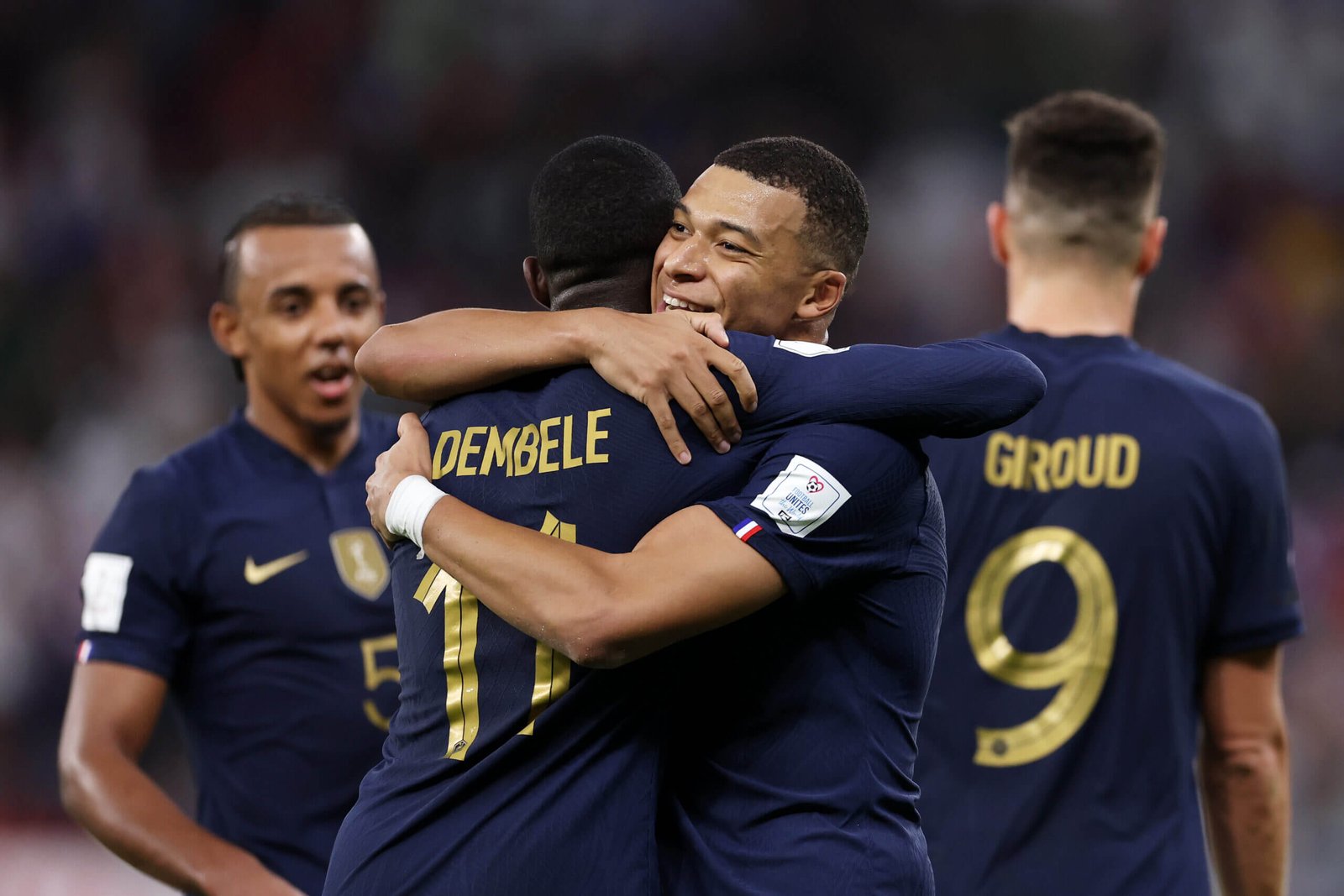
Mbappe and Dembele are celebrated by the French (Photo: Francois Nel/Getty Images)
Old rifts reopened in the years that followed but in 2018, when the French raised the trophy for a second time, their squad featured 20 players either born outside France or whose parents or grandparents hailed from elsewhere, according to research conducted by Remitly Global for their Together Were Stronger campaign, launched in association with Londons Migration Museum. France, once again, rejoiced in its multicultural sides success.
Around 89 per cent of the goals mustered by Deschamps team through their qualifying campaign for the current tournament were scored by migrants, as defined by Remitlys criteria. (By way of contrast, all Canadas goals in qualifying were netted by players of Caribbean, African and South American descent, while 86 per cent of those scored by the United States were supplied by migrants.)
The Tricolores are out again now, with France galvanised by its teams progress. The players are accepted, cherished and celebrated. And yet this hugely diverse squad arrived in Qatar after a fractious presidential election earlier in the year fought between the centrist Emmanuel Macron and the nationalist Marine Le Pen, a member of the National Assembly for Pas-de-Calais.
If she had won, Le Pens National Rally (RN) party had promised to hold a referendum with a view to introducing far tighter laws on immigration.
Macron eventually prevailed, but RN still captured a record 89 seats in the 577-seat National Assembly a rather jarring backdrop to Mbappe et al propelling the nations defence of the World Cup trophy.
The same diversity applies to Englands squad, for whom 82 per cent of the goals scored in qualifying came from players who would be classed as first-, second- or third-generation migrants. So, too, would six of their eight scorers in Qatar to date. Harry Maguire was eligible for both the Republic and Northern Ireland, and is one of several players of Irish heritage in the group. Bukayo Sakas mother, Adenike, was born in Nigeria, while others trace their roots to the Caribbean.
The issue of immigration is as divisive as ever in British society.
Concerns about overcrowding and the strain it places on a struggling economy are voiced regularly, fears repeated by those in charge of the country. Senior politicians have described the influx of asylum seekers as an invasion at the same time research by the Oxford Migration Observatory suggests the UK receives far fewer applications per capita than at least 10 other European nations.
But should Gareth Southgates team progress beyond France, even perhaps into Englands first World Cup final since 1966, then those same first-, second- and third-generation migrants propelling the team will be feted by the public and politicians alike.
During the teams journey to the European Championship final last summer, the Migration Museums Football Moves People campaign made a splash both on social media and billboards across the United Kingdom by pointing out how the players boasted family roots which spanned the globe. As their real-time graphics made clear, there were occasions when England without immigration would effectively have boiled down to a team of, at most, three or four.
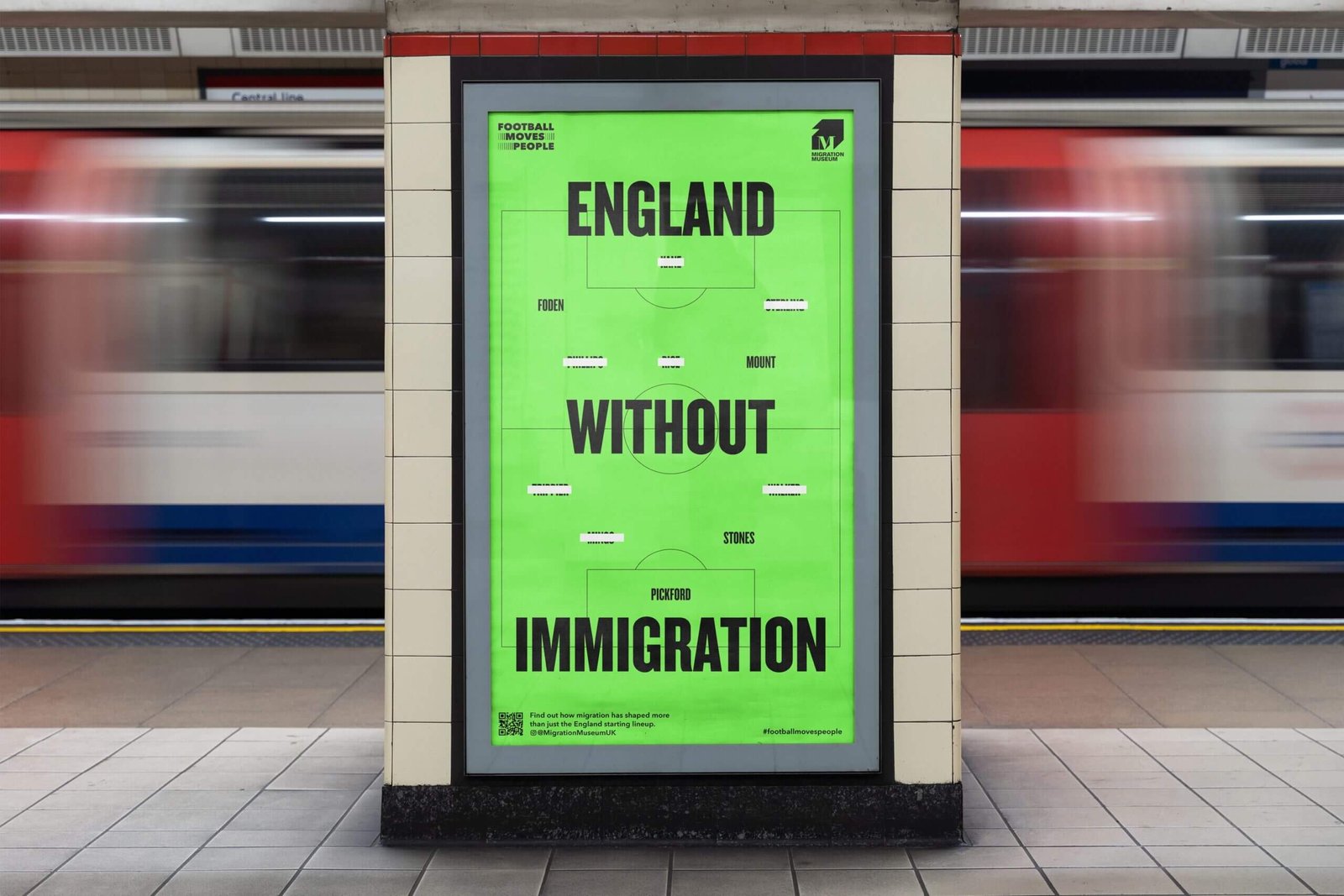
The England team from last years Euros without immigrants (Photo: Wonderhood Studios)
That would have been the case for Englands recent starting line-up against Senegal last week, too, says Matthew Plowright, a director at the Migration Museum. Right from the beginning, football and migration have been intrinsically linked. You can see that in the diversity of the England team, but also with the origins of the game and the way British factory workers migrants exported the sport to Uruguay, Argentina, Poland and Brazil.
The use of the word migrant has almost become dehumanising in so many contexts. So often, the political debate fixes upon how we, as a small island nation, can afford to let all these people come here. But its looked at in such a narrow way. We wanted to try and put personal stories back at the heart of it. To put people back at the heart of it. Every migrant is a person and every one has moved for their own personal reasons. And from business to sport, music to art, fashion and culture, our lives would not be the same without this movement from around the world, in and out of Britain.
It was interesting so many peoples reaction to the Football Moves People team graphics was, Wait, why is Harry Kane not there?. We ended up seeing the very depressing reaction to Englands penalty shootout defeat in the final of Euro 2020 (when Marcus Rashford, Bukayo Saka and Jadon Sancho were subjected to racist abuse on social media after missing their penalties), but migration is not a black-white issue. Its relevant across all races and backgrounds. The make-up of the national football teams competing on Saturday illustrates that.
Football would not be the same without migration.
Anglo-French political relations have proved tense since the United Kingdom voted through Brexit, their departure from the European Union, more than six years ago, with the issue of immigration a running sore between the two countries.
The UK bemoans the fact just under 42,000 refugees have crossed the Channel in small boats in 2022, according to figures released last month by the Home Office and Ministry of Defence. The French point out that they accept and provide asylum to significantly more people than that who cross their borders with other European nations.
Life then quickly degenerates into squabbling over the money that has been poured by the British into bolstering French border patrols (up from 55million to 63million this year) and whether it has been spent wisely, or the scheme to send those considered illegal immigrants who do make it across the Channel straight on to Rwanda in east Africa a resettling programme that remains mothballed after legal challenges.
They each regularly point fingers at shady people-smugglers, shirk responsibility for the deaths that occur so regularly in the Channel it is a little over 12 months since at least 27 people, with five others still missing, died in the worst maritime disaster for 30 years on that stretch of sea after their overcrowded dinghy capsized, with new evidence suggesting authorities from both countries passed the buck and failed to help when the incident was reported to coastguards. Instead, they discuss whether there is, indeed, any safe and legal route for the overwhelming majority of asylum seekers attempting to reach the UK. The home secretary, Suella Braverman, seemed stumped by that question at a recent appearance in front of a home affairs select committee.
It is an issue which unites both countries and simultaneously thrusts them ever further apart, but it is those lingering in Rue de Jude, and at other camps along the 40 miles from Calais to Dunkirk further along the French coast, who suffer most.
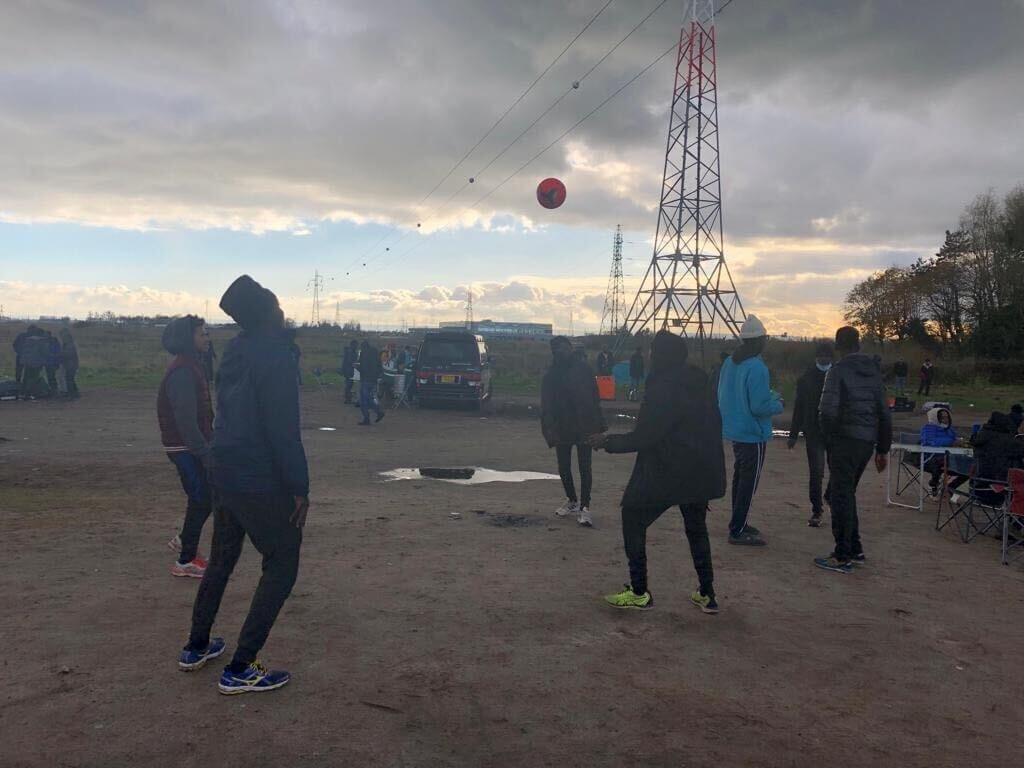
Most of those who attended Care4Calais distribution visit in midweek were Sudanese, but there were Afghans, Iraqis, Yemenis and Eritreans among the 100 or so present. The organisers estimated that more than 600 had visited on Saturday the local charities close for the weekend when the volunteers had given out shoes. Up to then, plenty of those playing football or wandering the streets of Calais had been doing so barefoot or in flip-flops and sandals.
Today we gave out more than 300 pairs of new boots to refugees in Calais. the pictures here say more than words can about the desperate need for them.
We will need more before winter ends; you can buy a new pair of boots for a refugee for Christmas here:https://t.co/GVJdhaRTYi pic.twitter.com/tG2Kwn8Uv1Care4Calais (@Care4Calais) December 4, 2022
The previous week, the charity had distributed 300 new winter coats. Tuesdays handouts were of socks and SIM cards, as well as leaflets on how to seek legal advice should they make it to the UK.
Of those present, all men, none appeared likely to have the money to pay a people smuggler to take him across the Channel.
Most will try hiding aboard lorries parked up outside the port, hoping to avoid the British police as they guide sniffer dogs up and down the rows of trucks to root out stowaways before departure.
Others take their chances in dinghies. The journey is perilous, but they have already endured so much in reaching Calais. And they are still desperate.
Many of those who do make it across claim asylum on arrival and are housed either in detention centres or hotels while their claims are processed. The Home Office says applicants should receive a decision within six months, but the reality is that more than 70 per cent do not hear back within that time. They cannot work while they wait. It may sound better than sleeping rough in Calais, but life in unfamiliar surroundings remains achingly dull and restrictive. Mental and physical health suffer.
Once again, football does provide some relief.
In leafy Surrey on Tuesday, Dorkings Meadowbank stadium will throw open its doors to a tournament that has become a monthly event in recent times. A 4G pitch more used to staging Dorking Wanderers fixtures in the fifth-tier National League will feature up to 16 seven-a-side teams consisting of asylum seekers housed at hotels in the county.
It all started with a friendly game between Surrey Police and around 40 refugees last April, but it has snowballed from there, says Rob Bryant, senior football development officer at the Surrey FA, which is based at the stadium. Weve had 27 different nationalities involved so far people from Iran, Syria, Afghanistan, Libya, Iraq and African countries going through civil unrest. But also Brazil, El Salvador, Canada and India.
The preconception of a refugee in this country is probably not a bloke from Canada or Honduras playing football with a massive smile on his face. One of the teams has representatives from five different continents. The whole exercise brings languages, cultures, religions together. Its almost cliche, but football does connect. It is global. We can see that here every month. And it is providing these guys with a rare chance to exercise properly, to improve their mental health.
It gives them something to look forward to.
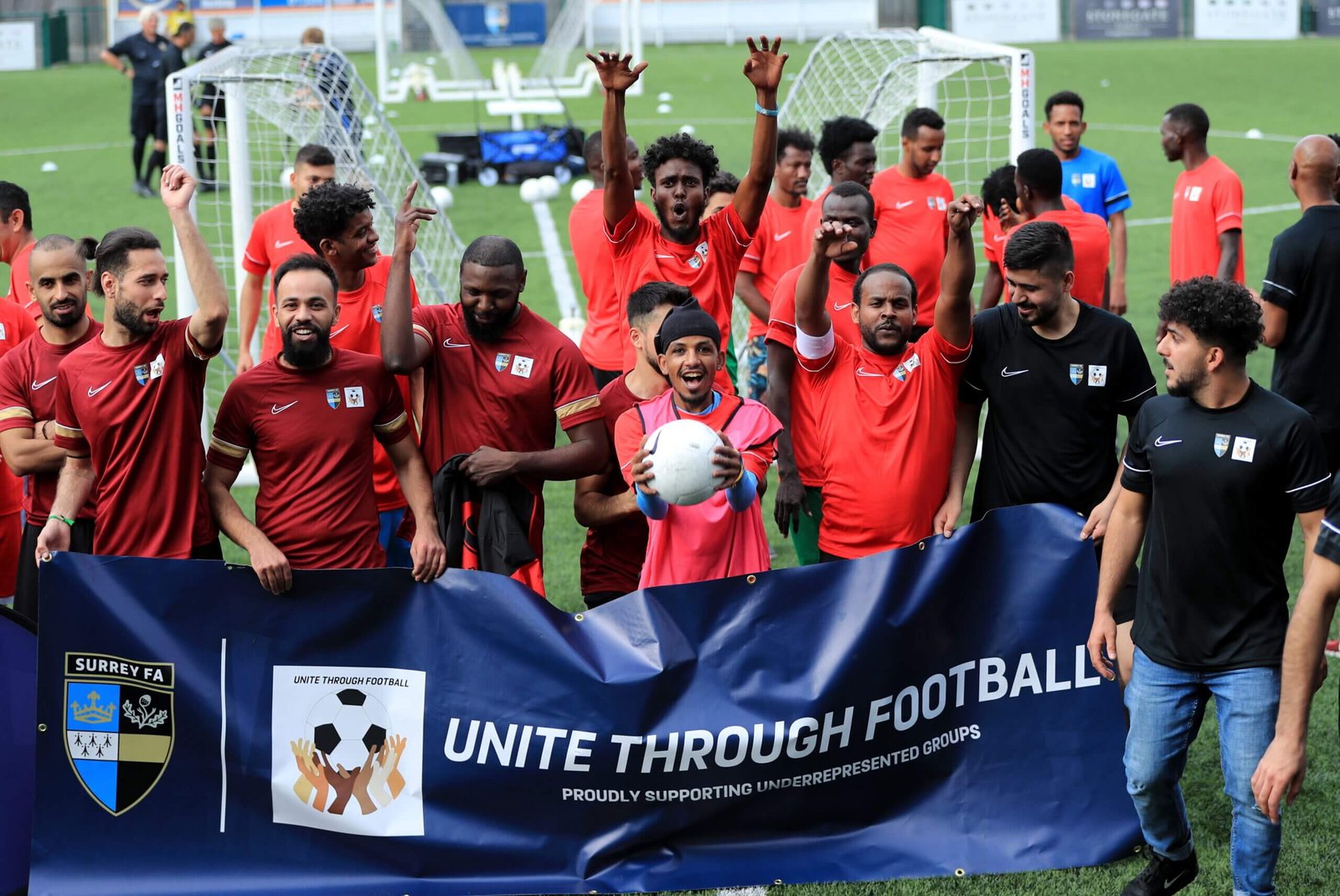
A Surrey FA Refugee League event in Dorking in September (Photo: Simon Roe)
Those involved are supplied with team shirts, shin pads and boots. A bulk order was placed at sportswear firm Decathlon by SBHL, who are contracted by the government to provide accommodation services for asylum seekers, and 18 boxes of kit were duly delivered to the Surrey FAs offices earlier this year. Next on the agenda will be a shipment of shorts. As part of the Unite Through Football: Refugees programme, the Surrey FA are already branching out to offer coaching and refereeing bursaries to the refugees, as well as pointing them towards local grassroots clubs.
The idea is to help embed them into the community, adds Bryant. If they are granted asylum and are able to work here, then having a coaching or refereeing qualification will help them earn a bit of extra money. But it should also ensure that, wherever they end up in the country, whether it be in Durham or Cornwall, they will know an equivalent county FA exists.
There should always be a football club down the road where they can fit in. These guys arrive here desperate, broken by everything they have experienced. It is about providing a bit more structure and enjoyment in their lives.
The closest those still in Calais have to that are the charities visits.
Those drifting to the site in midweek have been alerted to the location of Care4Calais distribution by an online newsletter provided in nine languages by the charity Infobus. Even before the goals are set up, the pitch marked out and the balls retrieved from the minibus, football references abound. One Sudanese wears a Fulham bench coat, though he wants to make it clear that he actually supports Manchester United. Another sports a Manchester City scarf. There is even a Rochdale FC jacket on show.
Clare Moseley, the charitys founder, is keen to point The Athletic towards the story of Nani, a Manchester United and Marcus Rashford-obsessive who fled Sudan and was detained for a year in Libya. While there, his arm was broken when a bomb struck his detention centre. The same blast killed his elder brother.
The teenager was in Calais over the summer of 2021 when the above video was shot.
As far as the charity is aware, he has since made his way to Manchester.
All the stories from those still in northern France are hard to digest.
One Yemeni swam from Morocco to Spain and was picked up by the coastguard 700 metres from the Spanish shoreline. As he was hauled from the water he remembers praying that he was being apprehended by the Spanish and not the Moroccan authorities: If it is Moroccans, I am taken back.
An Afghan tells of his journey through Turkey and on into Europe. There were 23 of them when they started out. They woke one morning, somewhere high in the mountains, to discover two of their party had died overnight because they were so cold.
Another has asked about continuing his studies and is now quizzing Moseley over the differences between the respective asylum systems in France and England. The explanation that neither is particularly impressive is delivered with an apology but, seeing her face drop, he interjects.
You think all this is bad, he says, sweeping his arm out to take in the wasteland and the makeshift camps that have sprung up in the tree line. But it is not so bad. It is what it is.
And I feel safer sleeping here than I ever did in Sudan.